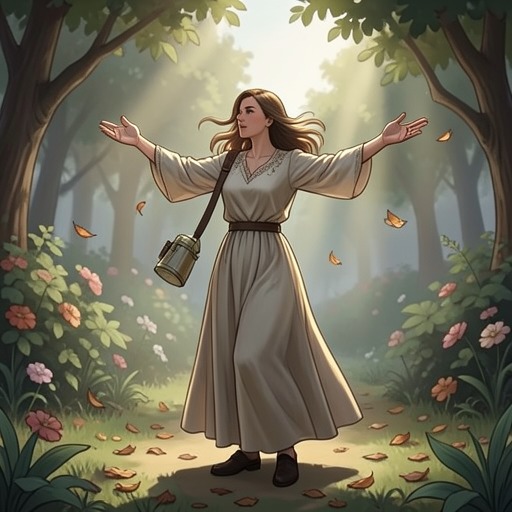
La ligereza es una forma de elegancia. Vivir con ligereza y alegría es dificilísimo
También esto pasaráThe expression “La ligereza es una forma de elegancia. Vivir con ligereza y alegría es dificilísimo” gives a name to Blanca’s aspiration to meet life with grace and joy, while admitting that doing so is extraordinarily difficult. It recurs not as an easy solution to grief or frustration, but as an ideal whose meaning is tested by ordinary pressures and by the difference between lightness and carelessness.
The Ideal and Its Difficulty
The novel’s introductory framing places the expression against the death of Blanca’s mother: grief and absence remain, yet memory and the reaffirmation of life—through friends, children, sex, and important relationships—also matter. The saying’s two-part structure holds that tension in miniature. Lightness may be elegant, but living lightly and joyfully is difficult; the second thought prevents the first from sounding like a simple command to be cheerful.
Blanca says that she has repeated the phrase herself. Its recurrence makes it a personal maxim, but not proof that she has mastered the conduct it describes. Rather, the maxim articulates a standard she reaches for even when the circumstances around her make ease elusive.
On the Road to Cadaqués
The phrase returns during the journey to Cadaqués, as Blanca travels with the children and notices Elisa and Damián in the neighboring lane, riding in their own car. She imagines them enjoying music of their choice and talking or thinking without the children’s demands. Her comparison sharpens when she recalls that she has been unable to shower alone: the children interrupted to ask about a Chinese mandarin costume they considered essential for the trip. The scene sets the appearance of unencumbered freedom beside the bustle of caregiving, without suggesting that either life is wholly simple.
The phrase follows this domestic comedy and frustration. Blanca recalls that her second ex-husband was driven to distraction by Ursula’s habit of responding to any situation with laughter, whereas Blanca herself found it amusing. She then voices the maxim as something she used to say. In this setting, lightness is not an abstract ornament: it sits beside the crowded car, the children’s insistence, and Blanca’s envy of Elisa and Damián’s apparent freedom.
The Reproach Within the Maxim
The saying does not go unchallenged. Blanca’s mother replies, “Tú confundes la ligereza con el pasotismo, Blanquita. A ti te toma el pelo todo el mundo.” The distinction is pointed: what Blanca calls lightness may, to her mother, look like indifference or a willingness to let others take advantage of her. The maxim’s elegance therefore carries a risk. Its value depends on how it is lived, not simply on how gracefully it sounds.
That exchange keeps the expression from settling into a tidy moral. Blanca’s aspiration to live with lightness and joy persists, but her mother’s correction exposes the gap between an ideal and its possible misreadings. Set within a summer shaped by bereavement and family obligations, the phrase holds both a desire for livability and an awareness that neither grief nor responsibility can simply be waved away.